
A pet traveling in the aircraft hold is not necessarily being shipped as cargo. Here is what families should understand about two very different kinds of pet travel.
When families learn that their dog is too large to travel in the passenger cabin, they often assume the only alternative is to ship their pet as cargo. That is not always true.
On certain airlines and routes, a dog or cat can travel in the aircraft’s climate-controlled hold as accompanied excess baggage. The pet is added to a passenger’s reservation, checked in at the airport, transported on the same flight as that passenger and reunited with them after landing.
That may sound like cargo because, in both situations, the pet travels below the passenger cabin. But the two services are fundamentally different.
With accompanied excess-baggage travel, a Cabin Companion makes the pet’s reservation, prepares the pet and crate, personally handles airport check-in, flies on the same plane and retrieves the pet at the destination.
With manifest cargo, the pet is booked as an independent air-freight shipment. The journey moves through cargo terminals, shipping systems, airway bills and handling networks rather than as part of a passenger reservation.
Cargo is not inherently unsafe, and for some pets and destinations it may be the only available option. It is not, however, a service Cabin Companions provides. Our work is built around continuity of care: one accountable person following your pet’s journey, making decisions in real time and remaining responsible until your pet is safely home. If a transportation method does not allow us to uphold that standard, we do not offer it.
A pet can travel in the aircraft hold without traveling alone.
First, What Does “Excess Baggage” Mean for a Pet?
Airline terminology is confusing, in part because several different terms are often used for pets traveling below the passenger cabin. You may hear:
- Checked pet
- Checked baggage
- Excess baggage
- Accompanied baggage
- Pet in the hold
- Air cargo
- Manifest cargo
- Unaccompanied cargo
Some of those terms describe animals traveling in the same physical area of an aircraft, but they do not describe the same kind of journey. The simplest distinction is how the pet is booked and whether someone responsible for the pet travels with them.
Accompanied excess baggage
The pet is attached to the reservation of a passenger traveling on the same flight. That passenger—or a professional escort acting on the family’s behalf—brings the pet to the airport, checks the pet in, travels on the same plane and retrieves the pet after arrival.
Manifest cargo
The pet is booked as a separate cargo shipment under an airway bill and is generally delivered to an airline cargo facility rather than checked in as part of a passenger’s journey. Depending on the route, cargo agents, freight forwarders, brokers and other handlers may coordinate different portions of the shipment. The person arranging the move does not necessarily travel on the aircraft—or travel at all.
This is more than a difference in vocabulary. It changes the structure of the journey and the continuity of care surrounding the pet.
How Cabin Companions Handles Excess-Baggage Travel
Excess-baggage travel is most commonly considered when a pet—usually a dog—is too large to travel beneath an airline seat. When Cabin Companions arranges this kind of journey, we approach it much as we would an in-cabin trip: we research the airline, aircraft, airports and country-entry requirements, confirm that the itinerary and pet program are appropriate for the individual animal and crate, and then add the pet to our own passenger reservation.
On travel day, we:
- Bring the pet to the airport ourselves
- Make sure the travel crate is correctly prepared
- Provide permitted water, food and other supplies
- Attach identification and travel information
- Use tracking equipment when permitted and appropriate
- Present the required veterinary and entry documents
- Personally complete airline check-in
- Remain at the airport until the pet has been accepted
- Travel on the same flight or itinerary
- Retrieve the pet after arrival
- Complete the applicable customs or entry process
- Continue with the pet to the final destination
Once the pet has been checked in, trained airline and airport personnel handle the crate and transport it to and from the aircraft. We do not pretend the pet remains physically beside us or that we can access the hold in flight. What we can promise is that we remain part of the same journey: we know when the pet was checked in, we are aboard the same aircraft, we can respond when the flight lands, and we are waiting when the pet is returned.
Another benefit is having a responsible person physically present throughout the journey—someone who knows the dog and has the authority to make decisions on the family’s behalf. An escort cannot remain beside a pet inside every restricted handling area, but we are at the airport, traveling on the same plane and available if airline staff need information or a decision.
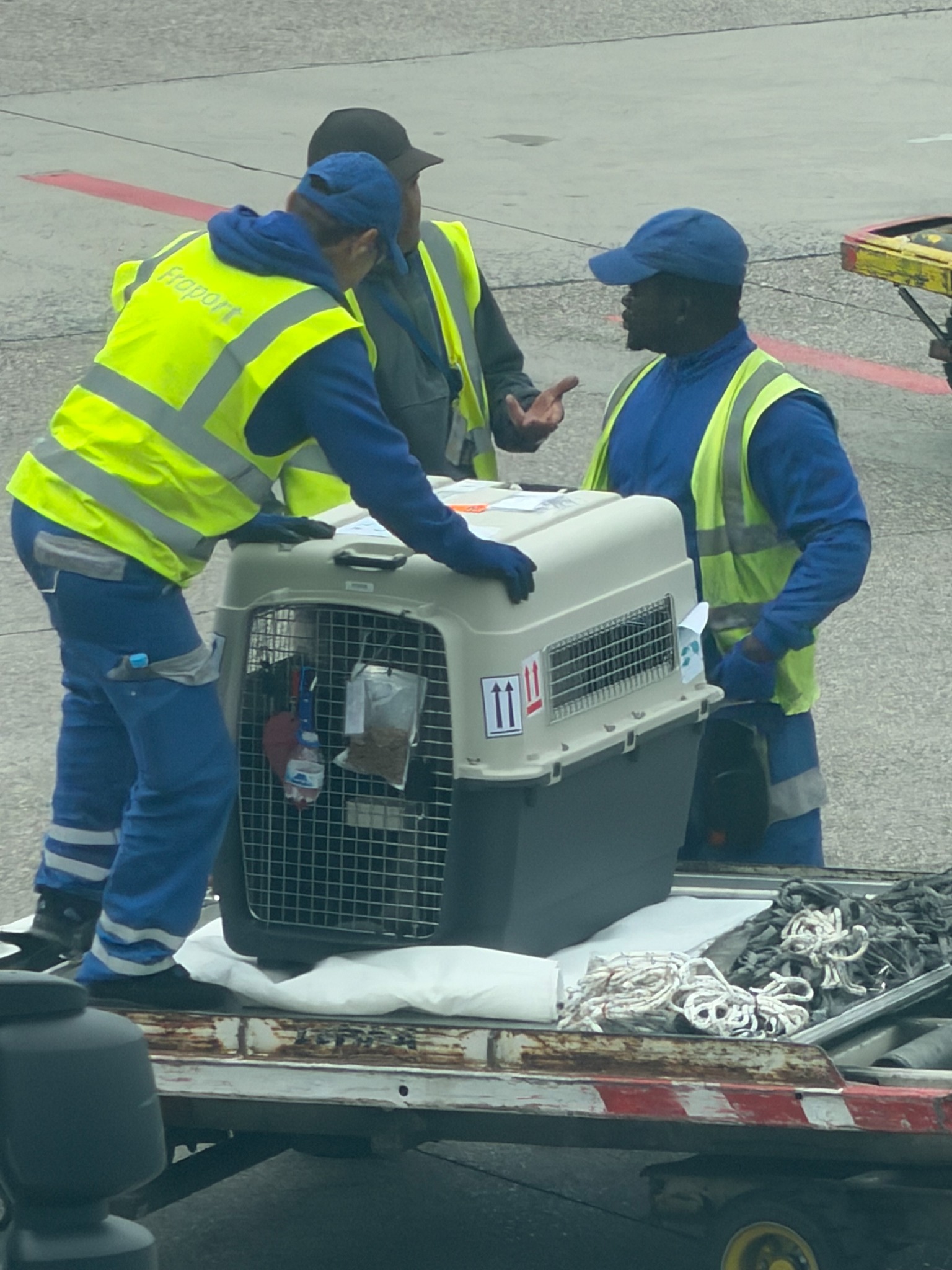
During Teddy’s connection in Frankfurt, I stayed where I could watch Lufthansa’s team care for him and load his crate onto the next aircraft. If a concern had arisen or the itinerary had changed, the team could have located me immediately. Teddy was moving through the airport with the person responsible for him close at hand and ready to make moment-by-moment decisions if needed.
Lufthansa, for example, permits eligible dogs and cats over its in-cabin weight limit to travel as excess baggage in the aircraft’s air-conditioned hold. The pet must be registered in advance and travel in a compliant container that provides enough room to stand, turn and lie down naturally. (Lufthansa)
Teddy’s Journey from Massachusetts to Valencia
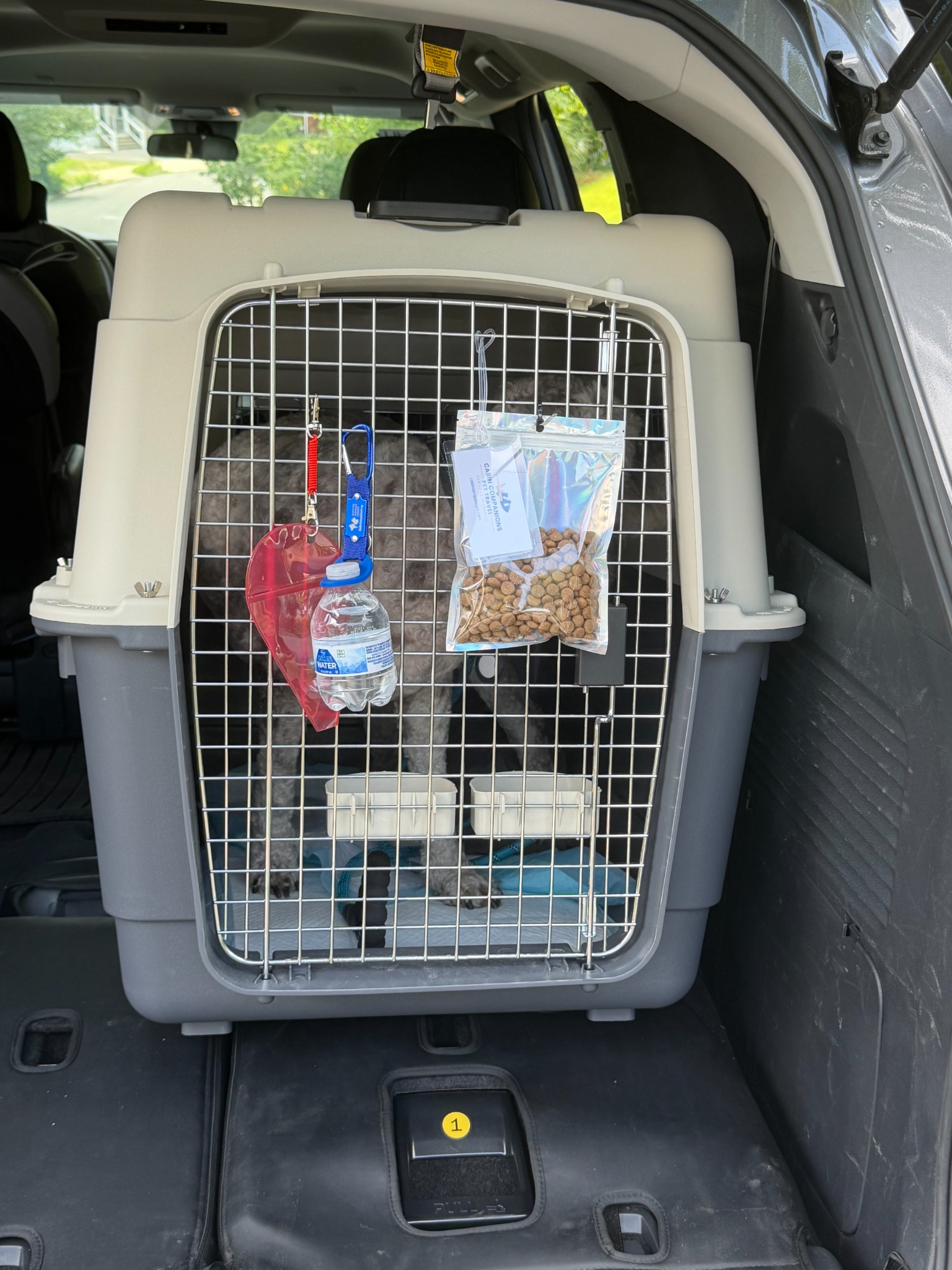
Teddy was too large to travel in the passenger cabin, so I picked him up just outside Boston and accompanied him to his new home in Valencia, Spain. Before we left for Logan, we had time to get acquainted, let him settle around me and take one last walk. I prepared his crate with identification, water, food and the supplies he would need, then brought him to the airport and personally checked him in for our Lufthansa itinerary through Frankfurt.
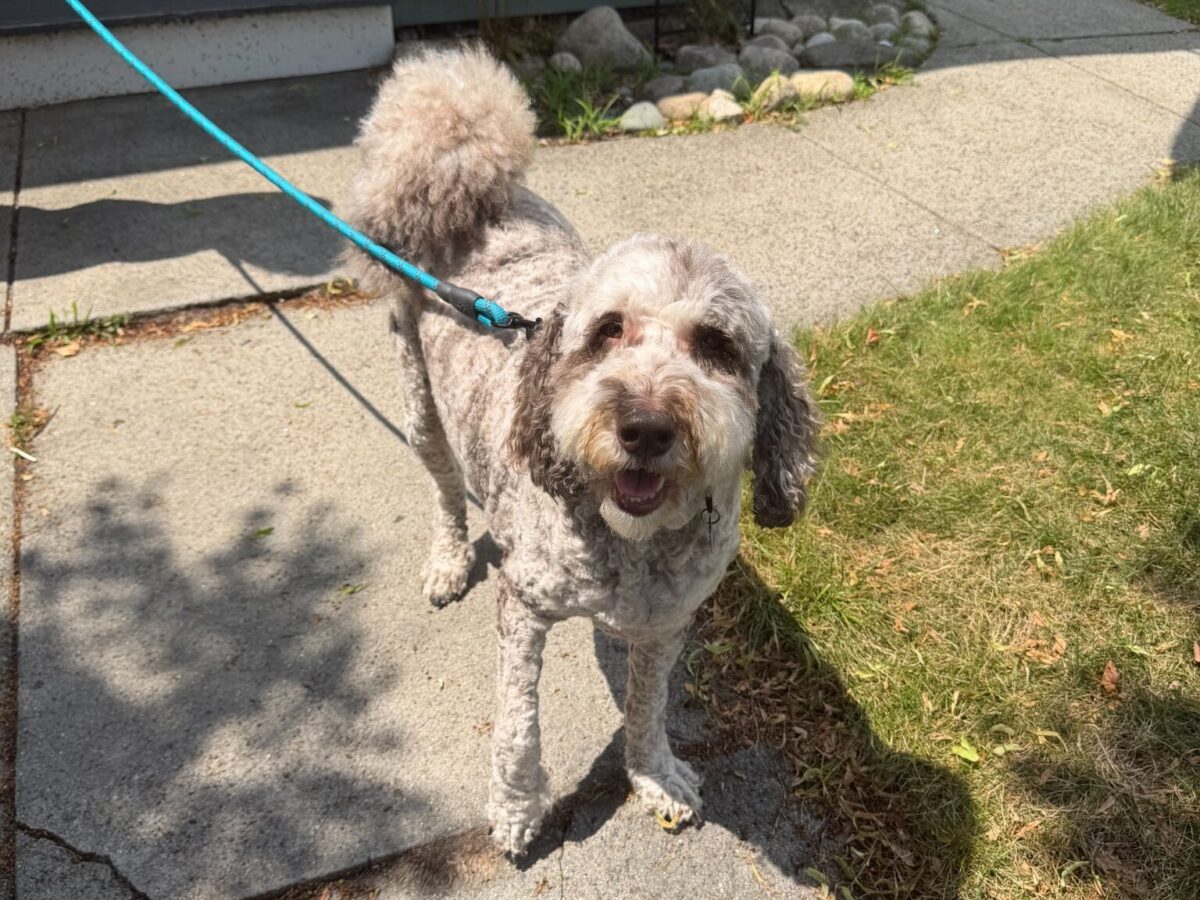
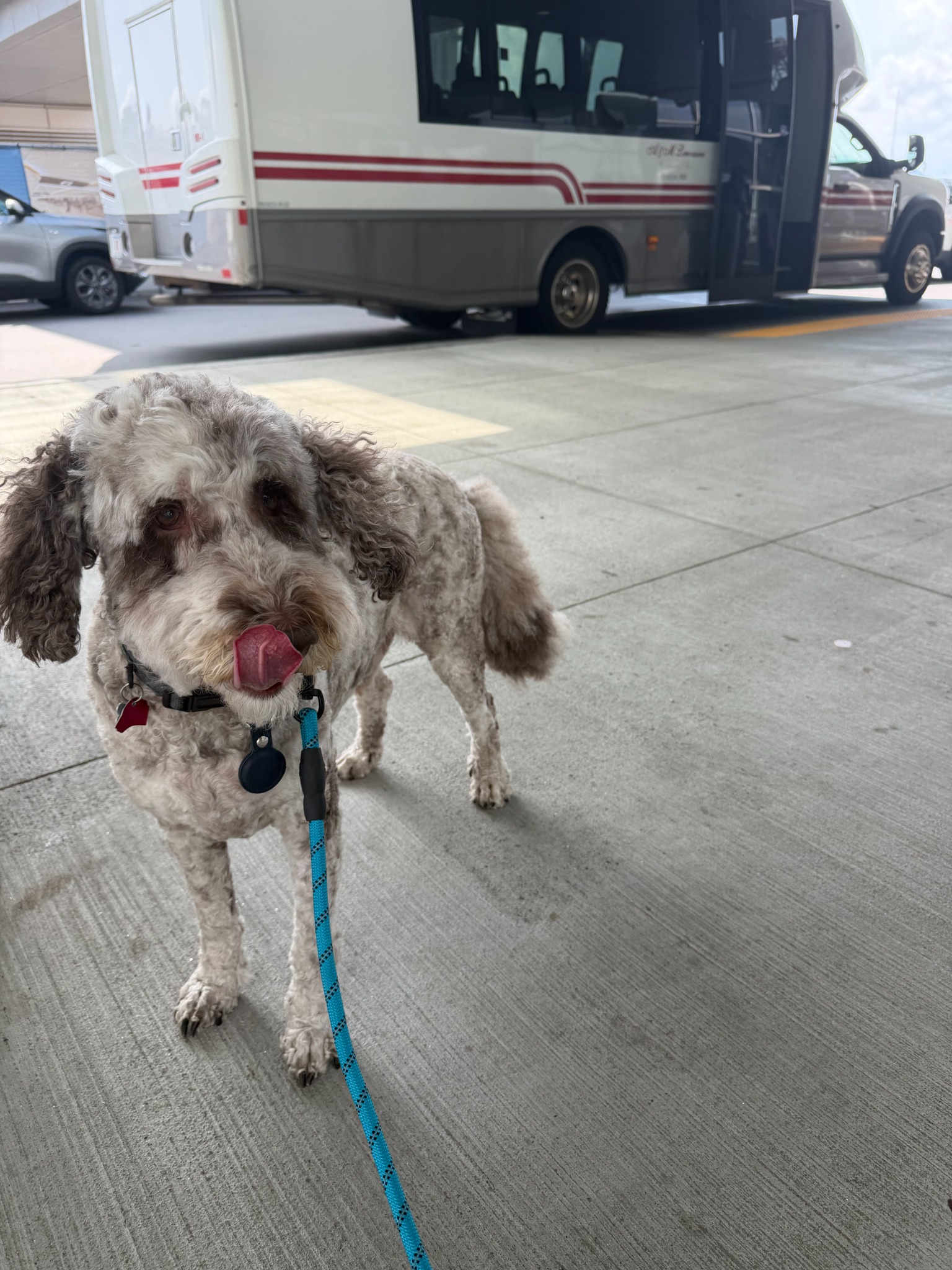
After Lufthansa accepted Teddy, I boarded the same flight. That is the most basic promise of accompanied excess-baggage travel: Teddy was going where I was going, not entering a separate shipping system while I waited elsewhere to learn when—or how—he would arrive.
During our connection in Frankfurt, I stayed back long enough to watch Teddy’s crate being handled on the ramp and prepared for the next aircraft. The staff did not rush him: they checked the crate, positioned it carefully and secured it for transport. Being able to see the people handling Teddy—and the care they were taking—mattered to me.
Frankfurt has specialized procedures for animals traveling through the airport. Its published guidance explains that connecting pets may be visually inspected, have their water checked and, depending on the length and nature of the connection, receive care through Frankfurt’s animal-handling operation. Lufthansa Cargo also operates a dedicated Animal Lounge at Frankfurt with trained animal-care personnel and facilities for animals in transit. (Lufthansa Cargo)
Passengers generally cannot visit pets during this portion of a connection, and the exact process depends on how the animal is booked and the length of the transit. But Frankfurt’s experience handling live animals—and the care I personally observed on the ramp—made it a particularly strong connection point for Teddy’s itinerary.
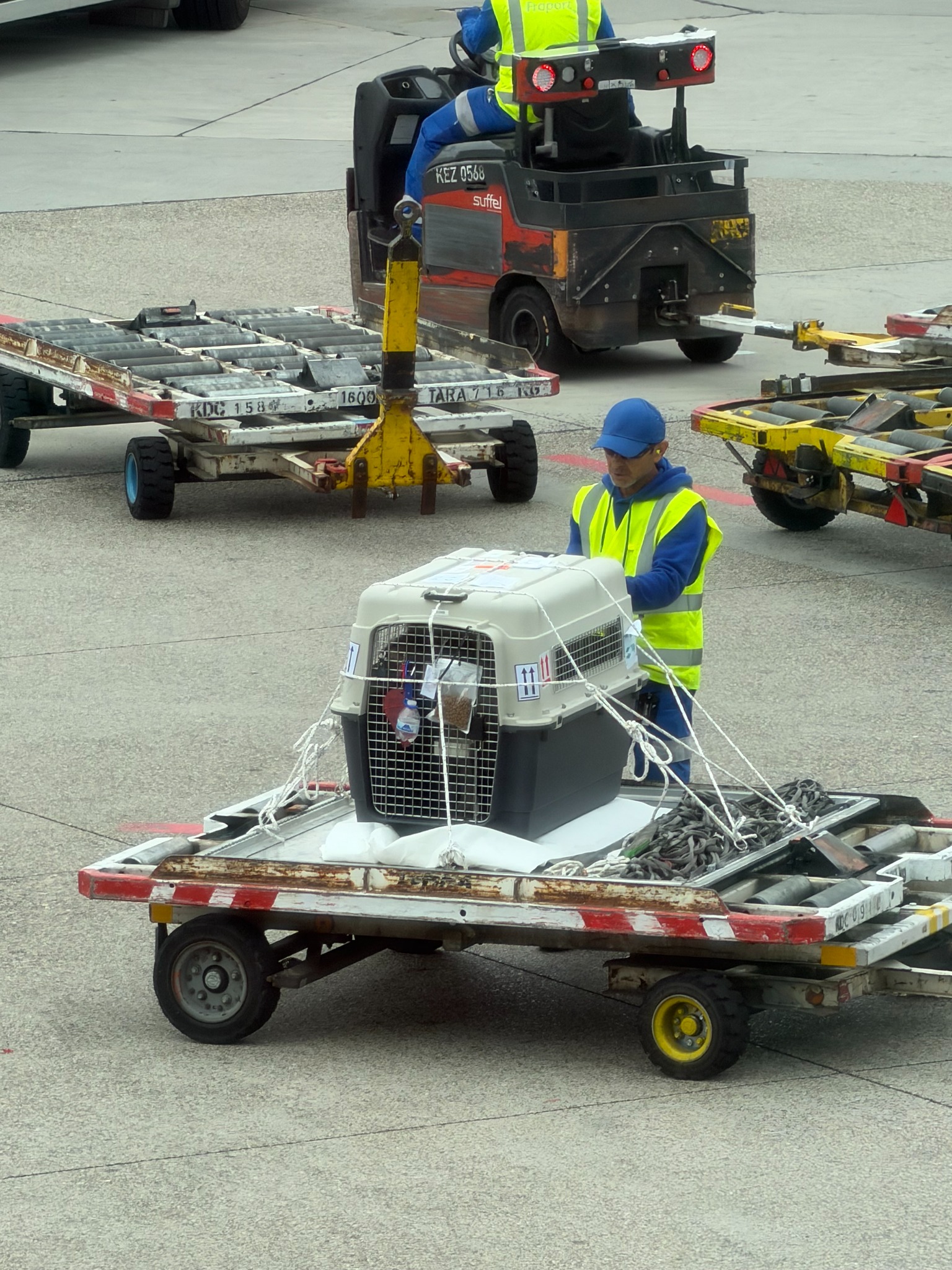
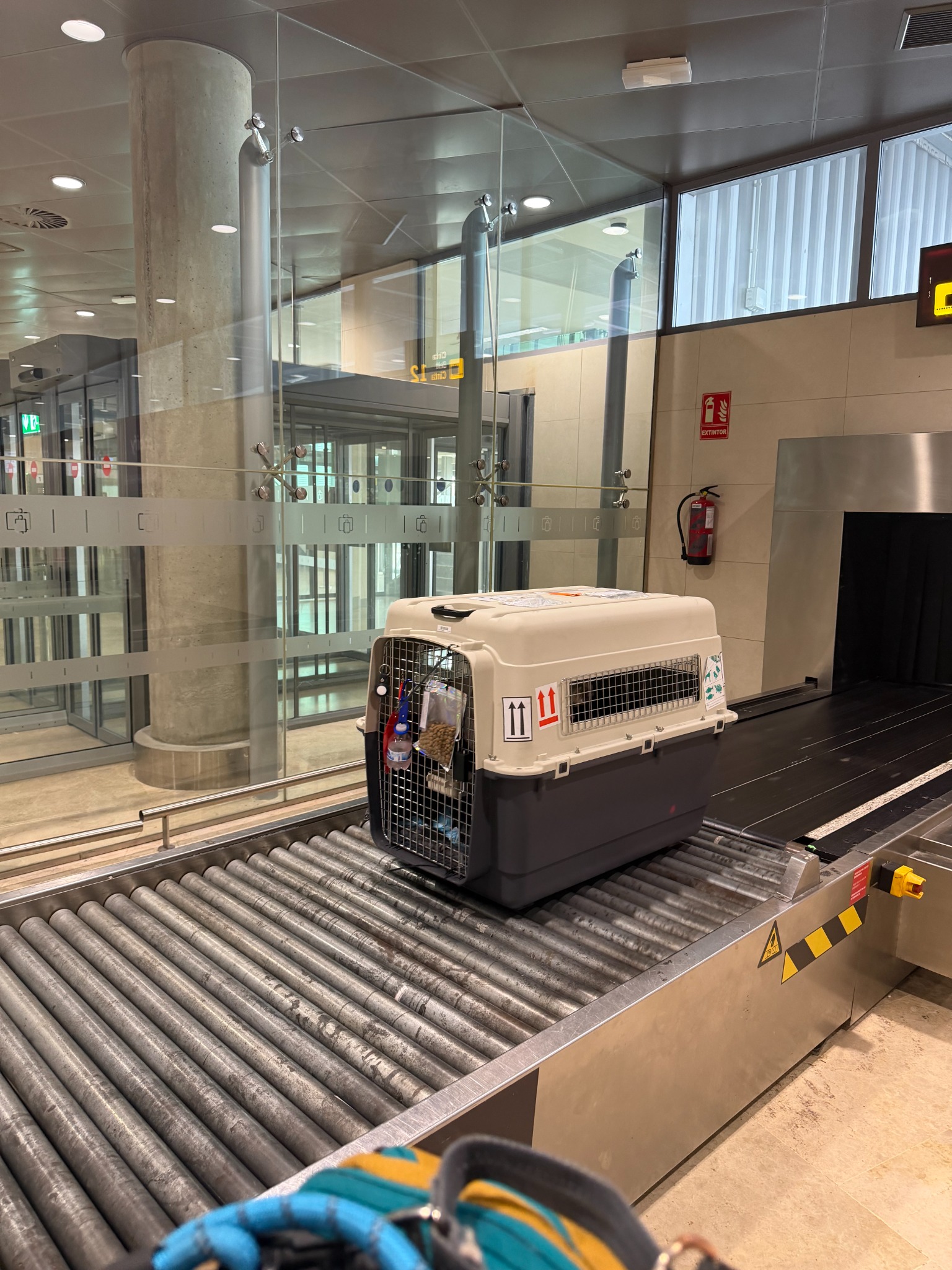
Teddy traveled in the aircraft hold, but he did not travel alone. He was not an independent freight shipment moving through an itinerary disconnected from the person responsible for him; I knew which flights he was taking because they were my flights, too. When his crate arrived in Valencia, I was standing at baggage claim waiting for him.
Why Continuity of Care Matters
The value of accompanied travel goes well beyond knowing a flight number. It allows us to plan the pet’s care around the complete journey, including:
- Coordinating food and water around airline requirements
- Monitoring the pet immediately before check-in
- Communicating directly with airline personnel
- Responding to a delay or canceled flight
- Adjusting ground transportation when schedules change
- Observing the pet as soon as the airline returns them
- Providing water, food, a bathroom break or other appropriate care after arrival
- Completing customs and entry procedures in person
- Continuing directly to the pet’s destination
For Teddy, that continuity also protected his medication schedule. His veterinarian-directed travel plan included prescribed medication, which I could give him at the appropriate time before check-in and again promptly after the airline returned him to me. That kind of precisely timed care is generally not possible when a pet is handed over as an independent manifest-cargo shipment.
Airport and cargo staff should not be expected to administer routine medication during transit. Even where written medication information can be attached to a crate, that is not the same as having the pet’s own escort available immediately before check-in and immediately after arrival.
For Teddy, traveling together did not just mean knowing which flight he was on. It meant preserving the carefully timed care plan his health and comfort required.
Any medication used for travel should be prescribed by a veterinarian familiar with the individual pet. The veterinarian should determine whether the animal is healthy enough to fly, whether medication is appropriate and how it should be administered.
What Happens When a Pet Travels as Manifest Cargo?
Manifest cargo begins with a different model. Rather than adding the pet to a passenger reservation, the animal is booked as freight under an airway bill. Depending on the airline, route and destination, the journey may involve:
- An airline cargo facility
- A freight forwarder
- A commercial pet shipper
- Customs brokers
- Veterinary inspection facilities
- Ground-handling contractors
- Separate cargo acceptance and collection appointments
The pet may need to be delivered to a cargo terminal hours before departure. At the destination, release may depend on customs, veterinary inspections, broker availability and cargo-facility operating hours.
A reputable cargo company should provide the family with clear itinerary and transportation information. It would be unfair and inaccurate to suggest that every animal traveling as cargo simply disappears onto a completely unknown aircraft.
What generally is not part of that model is one person accompanying the pet as a passenger from beginning to end. The pet moves from one part of the cargo and airline system to another, giving the family less direct visibility, fewer opportunities to intervene and no single escort maintaining hands-on continuity at both ends of the flight.
Cargo companies may perform careful, professional work, airline personnel may handle the pet appropriately, and specialized animal facilities may provide excellent care. Even so, the chain of responsibility is fundamentally different.
That is why manifest cargo does not fit the Cabin Companions service model. We are not declaring that all cargo transportation is unsafe; we are acknowledging that we cannot promise our standard of care within a system we do not personally accompany or directly oversee.
Does Manifest Cargo Automatically Make a Pet’s Entry “Commercial”?
Not necessarily. This is another area where the terminology causes confusion: commercial movement is a regulatory classification, while manifest cargo is a method of air transportation. The two may overlap, but they are not interchangeable.
For a pet to enter the European Union under its standard non-commercial pet-travel rules, the movement cannot be for the sale or transfer of ownership. The pet must generally travel with the owner or with an authorized person acting on the owner’s behalf.
When an authorized person accompanies the pet instead of the owner, the owner generally must travel within five days before or after the pet and provide the required written authorization and declaration. When those conditions are not met, the animal may need to comply with a different and more complicated set of animal-import requirements. (European Commission)
That means:
- A pet traveling in the hold as excess baggage is not automatically a commercial movement.
- A pet traveling as manifest cargo is not automatically considered commercial solely because an airway bill is used.
- The purpose of the move, ownership arrangements, timing of the owner’s travel, number of animals and destination rules all matter.
- A journey involving a sale, adoption or transfer to a new owner may be classified differently regardless of whether someone accompanies the pet.
These rules are technical and destination-specific, which is why families should not select a transportation method first and assume the paperwork can be fitted around it afterward. We evaluate the pet, route, ownership circumstances, owner’s travel and destination requirements together before determining whether a personally accompanied option is legally and practically available.
Why Excess-Baggage Travel Is So Limited
Accompanied excess baggage can be an excellent option, but it is not available for every journey. Many major U.S. airlines no longer broadly accept pets as checked baggage, while others limit the service to particular passengers, routes or circumstances. International airlines may provide more options, but approval still depends on the complete itinerary.
Common limitations include:
Airline and route restrictions
An airline may accept checked pets on one route but not another.
Codeshare flights can also complicate matters. A ticket may display one airline’s name while another carrier operates the aircraft and follows an entirely different pet policy.
Aircraft limitations
Not every aircraft can safely carry live animals in the hold. Available space, ventilation systems and crate dimensions can all affect eligibility.
Even when an airline normally transports pets, the particular aircraft assigned to a flight may not be suitable.
Crate size
The pet must travel in an airline-compliant crate large enough to stand naturally, turn around and lie down comfortably.
Some dogs require crates too large for the available aircraft or route.
Breed restrictions
Brachycephalic, or snub-nosed, dogs and cats face an elevated risk of respiratory and heat-related complications during air travel.
Many airlines prohibit them from traveling in the hold. Lufthansa, for example, does not permit snub-nosed dog and cat breeds to travel in the aircraft hold as excess baggage. (Lufthansa)
Other breeds may require reinforced crates or be subject to additional airline restrictions.
Temperature and heat embargoes
Airlines may refuse to accept a pet when temperatures at the departure, connecting or arrival airport create an unacceptable risk.
These restrictions can apply even though the designated aircraft hold is climate-controlled because portions of the journey—including loading and unloading—take place outside on the airport ramp.
The pet’s health and age
A pet may technically meet an airline’s rules and still be a poor candidate for air travel.
Age, heart or respiratory disease, mobility limitations, severe anxiety, medical fragility and other individual factors must be considered.
A veterinarian who knows the pet is an essential resource when determining whether air travel is medically appropriate.
Destination requirements
Some countries require certain pets to arrive through approved cargo channels. Others allow accompanied arrival only through designated airports or during specific inspection hours.
Excess baggage is an option. It is not a universal workaround.
Why Cabin Companions Does Not Coordinate Manifest Cargo
There are experienced companies that specialize in manifest-cargo pet transportation. Cabin Companions is not one of them; we specialize in personally escorted travel. Our service is built around a real, accountable person who learns about your pet, prepares for the journey, communicates with your family, travels on the same plane and remains responsible through arrival.
That responsibility shapes every decision we make:
- Which airline we select
- Which airports and connections we trust
- How the crate is prepared
- When the pet eats and drinks
- How a veterinarian-directed medication plan fits the journey
- What happens after a delay
- Who speaks with airline personnel
- Who retrieves the pet
- Who completes customs
- Who brings the pet home
Manifest cargo may successfully move a pet from one airport to another, but it does not allow us to provide the continuous, personally accountable care that defines Cabin Companions. We do not participate in journeys where we cannot uphold that promise.

Frequently Asked Questions
Is excess-baggage pet travel the same as cargo?
No. In both cases the pet may travel in the aircraft hold, but the booking and handling arrangements are different. An excess-baggage pet is attached to the reservation of a passenger on the same flight; a manifest-cargo pet is booked as an independent freight shipment under an airway bill.
Is the aircraft hold safe for pets?
Aircraft approved to transport live animals use a designated hold that is pressurized and climate-controlled during flight.
However, safety depends on much more than the temperature inside the aircraft. The pet’s health, breed, crate, route, weather, ground-handling time and airline procedures must all be considered. No form of pet travel is appropriate for every animal.
Can a Cabin Companion fly with my large dog?
Possibly. Excess-baggage travel is limited by the airline, route, aircraft, crate size, breed, season and destination regulations. We evaluate every journey individually before determining whether accompanied air travel is feasible.
Will my dog be beside the Cabin Companion during the flight?
No. A pet traveling as excess baggage remains in an airline-approved crate within the designated aircraft hold. The Cabin Companion travels on the same flight, personally handles check-in, remains responsible for the itinerary and retrieves the pet after landing, but cannot access the hold during flight.
Can my pet receive medication during the flight?
Families should not assume airline or airport staff will administer medication during transit.
When veterinarian-prescribed medication is required, we work with the family and veterinarian to determine whether the dosing schedule can safely be accommodated before check-in and after the pet is returned to us. The veterinarian—not Cabin Companions—must determine the medication, dosage and timing.
Can brachycephalic dogs travel as excess baggage?
Many airlines prohibit snub-nosed breeds from traveling in the hold because of their increased vulnerability to breathing and heat-related complications. Even when an airline appears to allow a particular pet, veterinary guidance and the animal’s individual health must take priority.
Is excess-baggage pet travel available within the United States?
Sometimes, but the options are limited. Most major U.S. passenger airlines do not offer a broadly available checked-pet program. Certain airlines, routes or passenger categories may still qualify, and some international carriers accept excess-baggage pets on eligible flights departing from the United States.
Does Cabin Companions arrange manifest cargo?
No. We do not book, coordinate or manage manifest-cargo shipments. Our service is built around personally accompanying pets, so when a journey requires an independent cargo shipment, the family needs a company specializing in that transportation model.
How do I know which option my pet needs?
The answer depends on much more than the pet’s weight. We consider the pet’s size, breed, health, crate requirements, origin, destination, ownership circumstances, owner’s travel, import classification, season, airline policies and available aircraft before recommending a route.
Could Personally Escorted Travel Work for Your Pet?
A pet who cannot fit beneath an airline seat does not always need to travel as an independent cargo shipment. On the right route, with the right airline and for the right pet, accompanied excess-baggage travel may allow a larger dog or cat to fly with the oversight, continuity and accountability of a professional escort.
We will not promise that an accompanied option exists until we have evaluated the complete journey. When it does, we prepare your pet, check them in, fly on the same plane and stand waiting when they arrive—rather than handing them into a shipping system to be met by someone else at the other end.
One journey. One accountable companion. One family at a time.
Tell Us About Your Pet’s JourneyExplore Personally Escorted Travel